What Is SPBE and What Local Governments Need to Prepare
SPBE often sounds like an apps-only matter. It is assessed on policy, governance, management, and services. Here is a short map for local governments starting to tidy up.

SPBE stands for Sistem Pemerintahan Berbasis Elektronik, Indonesia's electronic-based government system: how government bodies use information technology to run administration and deliver services. Every ministry, agency, and local government is expected to apply it and is assessed regularly through the SPBE Index.
The most common misunderstanding is treating SPBE as "having many apps". The assessment looks at whether those apps are managed, connected to each other, and actually used.
The regulations to know
- Presidential Regulation No. 95 of 2018 on the Electronic-Based Government System.
- Presidential Regulation No. 132 of 2022 on the National SPBE Architecture.
- Minister of Administrative and Bureaucratic Reform Regulation No. 59 of 2020 on monitoring and evaluating SPBE.
Rules can be updated, so always check against the latest version from the Ministry of Administrative and Bureaucratic Reform (KemenPANRB) before drafting planning documents.
What is assessed
- Policy: regional head regulations, architecture, and the regional SPBE roadmap.
- Governance: the coordination team, roles across regional agencies, and budget planning.
- Management: data management, IT assets, information security, and human resources.
- Services: administrative and public services that are already digital and integrated.
Preparation checklist for local governments
- Inventory apps and data. List every application, its owner, where its data lives, and what overlaps.
- An SPBE coordination team with clear leadership and a representative from each regional agency.
- Architecture and roadmap that guide decisions before buying or building new apps.
- Shared data standards: formats, region codes, and an owner for each dataset, in line with One Data Indonesia.
- Information security: access policy, backups, and a recovery plan.
- Service integration: applications exchange data through documented interfaces instead of manual re-entry.
- Evidence of use: record real user numbers and running services, because the evaluation looks at adoption, not just existence.
Common mistakes
- Building a new app per agency without a shared architecture, so data fragments.
- Finishing an app with no maintenance budget or team to run it.
- Thinking about security only after a website or app gets hacked.
- Complete policy documents that are never used in everyday decisions.
Where to start
Local governments with limited resources usually start with three things: an inventory of apps and data, one dashboard that brings priority data together for leadership, and basic security fixes. All three produce visible results while the policy documents are being written.
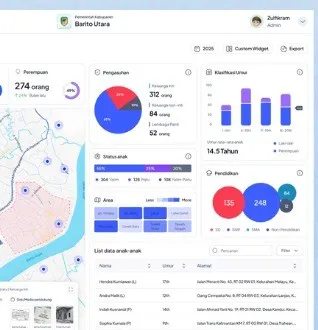
A regional example is the POMPy BATARA project of Barito Utara Regency, a thematic map portal that brings together data from several regional agencies. See also Sentra's government solutions and Data & Analytics service.
Tell us about the process. We'll help map out the most proportionate approach.